

Blog · 24 July 2026 · By M3M Properties
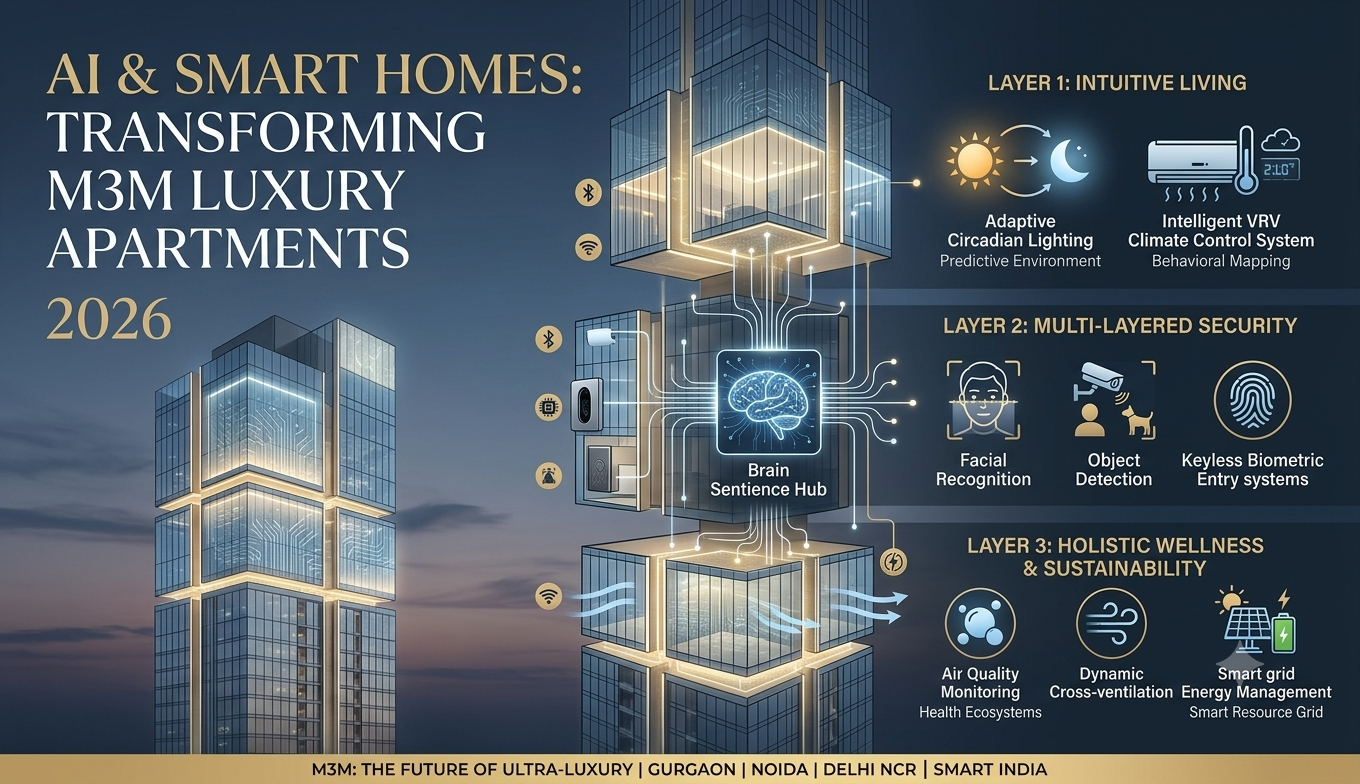
If you are shopping for a luxury apartment in Gurugram today, you have probably noticed that the pitch has changed. It is no longer just about marble lobbies and rooftop pools — it is increasingly about a home that knows you. Lights that adjust themselves, security that recognises your face, an air-conditioner that learns your routine, and a single app that runs the whole apartment from your phone. At M3M’s luxury addresses, artificial intelligence (AI) and smart-home technology are quietly becoming as expected as the imported fittings. Here is a plain-English look at what that means, how it works, and what to check before you buy.
What are AI-powered smart homes — and what has changed in 2026?
A “smart home” simply means a home where devices — lights, air-conditioning, locks, cameras, curtains, appliances — are connected to a network and can be controlled remotely or automatically. The newer, more powerful layer is artificial intelligence: instead of you programming every rule, the home learns your habits and makes decisions for you, from pre-cooling a room before you arrive to dimming the lights when a film starts.
What changed in 2026 is that this technology finally graduated from gimmick to genuinely useful. Voice control, facial recognition and energy optimisation have become reliable, affordable and easy to live with, and luxury developers have moved smart features from the brochure into the standard specification. For a brand like M3M — which has built its reputation on design-led, experience-first living — AI and automation are a natural extension of the promise: apartments that feel effortless, secure and intelligent from the moment you walk in.
Traditional apartment vs AI smart home: what the difference means
The easiest way to understand the shift is to compare a conventional premium apartment with an AI-enabled one across the things you actually feel day to day:
| What it affects | Traditional apartment | AI-enabled smart home |
| Lighting & climate | Manual switches and remotes; you adjust everything yourself | Learns your routine and daylight, adjusting lights and AC automatically |
| Security | Keys, a guard register and a basic intercom | Facial recognition, app alerts and remote video door access |
| Energy bills | Fixed habits; power is often wasted | Smart optimisation can trim energy use by roughly 15–25% |
| Daily control | Room by room, and only when you are physically there | The whole home from one app or your voice, from anywhere |
| Upkeep | You notice a problem once something breaks | Sensors flag issues early with predictive maintenance |
How AI smart-home features work in an M3M apartment: a walkthrough
Once you strip away the jargon, a smart luxury home is really just a series of small conveniences that add up. Here is how a typical day might flow:
- You arrive, and facial recognition or an app-based entry lets you into the tower and calls the lift for you — no fumbling for keys or cards.
- You step inside, and your preferred “scene” is already set: lights at the right level, the AC at your favourite temperature, and music on if you like it.
- Through the day, the home quietly learns your patterns and adjusts climate and lighting to keep you comfortable while cutting wasted energy.
- Cameras, motion sensors and smart locks keep watch; if something needs your attention, you get an alert on your phone and can see who is at the door from anywhere.
- You control everything by voice through an assistant such as Alexa or Google, or from a single app — curtains, appliances, lighting and more.
- As you leave, one tap sets “away mode” — securing doors and switching off unneeded devices — while leak, smoke and gas sensors keep monitoring in the background.
- The same app often extends to the community: visitor passes, amenity bookings, maintenance requests and utility bills, all in one place.
The smart-home features shaping M3M luxury apartments in 2026
Not every project offers every feature, but these are the technologies increasingly defining premium, tech-forward homes — and what each one actually does for you:
| Feature | What it does | Why it matters |
| Smart lighting & climate | Auto-adjusts to your routine and the time of day | Comfort with lower energy bills |
| AI security & facial recognition | Recognises residents and flags unknown visitors | Safety and effortless access |
| Voice assistants | Control the home hands-free by voice | Convenience for the whole family |
| Smart energy management | Monitors and optimises electricity use | Sustainability and real savings |
| App-based home control | One app for lights, locks, appliances and more | Manage your home from anywhere |
| Video door phone & smart access | See and admit visitors remotely | Security and peace of mind |
| Predictive maintenance | Sensors flag issues before they become failures | Fewer breakdowns and surprises |
A quick checklist before you buy a smart luxury home
Smart features are only as good as the way they are installed and supported. Run through this before you sign:
- Ask exactly which smart features are included as standard and which are paid add-ons.
- Check the ecosystem — is it a single app, and does it work with Alexa or Google Home?
- Confirm who maintains the system and what happens, and what it costs, if a device fails.
- Ask about data privacy — where camera and usage data is stored, and who can access it.
- Make sure there is reliable network infrastructure and backup power for critical systems.
- Test the app and a few features live during your site visit — not just in the brochure.
- Factor in any subscription or annual maintenance (AMC) costs for the smart-home platform.
Why AI and smart homes matter for luxury buyers
For a luxury buyer, smart technology is about more than novelty. It buys back time and attention: a home that manages its own lighting, climate, security and maintenance frees you to simply live in it. It adds a genuine layer of safety through facial recognition, remote monitoring and instant alerts. And it quietly saves money and energy, which matters more every year as sustainability moves to the centre of premium living.
There is a value angle, too. Tech-forward homes appeal strongly to younger high-net-worth buyers and tend to feel current for longer, which supports resale appeal and future-proofing. For M3M specifically, weaving AI and automation into design-led apartments reinforces exactly what the brand is known for — homes that feel considered, effortless and a step ahead. If you are comparing options across Gurugram and the wider NCR, the smartness of the home is fast becoming as important as the address itself.
Frequently Asked Questions
What is an AI-powered smart home?
It is a connected home where devices such as lights, air-conditioning, locks and cameras are controlled remotely or automatically, with an AI layer that learns your habits and makes decisions for you — like adjusting the temperature before you arrive.
Which smart-home features do luxury apartments like M3M’s offer?
Common features include smart lighting and climate control, AI-based security and facial recognition, voice assistants, energy management, app-based control of the whole home, video door phones and predictive maintenance. Exact inclusions vary by project and configuration.
Do smart homes really save money on energy?
Yes. By automatically optimising lighting, cooling and appliance use, smart systems can typically reduce energy consumption by around 15–25%, though actual savings depend on your habits and the home’s setup.
Are AI smart homes secure and private?
Well-designed systems improve physical security through monitoring and alerts. On data privacy, it is worth asking where camera and usage data is stored and who can access it, and choosing platforms with strong encryption and clear privacy controls.
Do smart-home features increase a property’s value?
They can help. Tech-forward homes appeal to modern buyers and tend to stay current for longer, which can support resale appeal — though location, quality and the developer’s reputation remain the biggest drivers of value.
What should I check before buying a smart luxury apartment?
Confirm which features are standard versus paid, how the system is maintained and supported, data-privacy arrangements, network and backup-power reliability, and any subscription or AMC costs. Always test the features live during your visit.
This article is for general information only and reflects features and trends reported as of mid-2026. Specific smart-home technologies, inclusions, specifications and costs vary by project, tower and configuration — please confirm the exact details with M3M’s official team before making any purchase decision. M3M and related project names and details belong to their respective owners.